

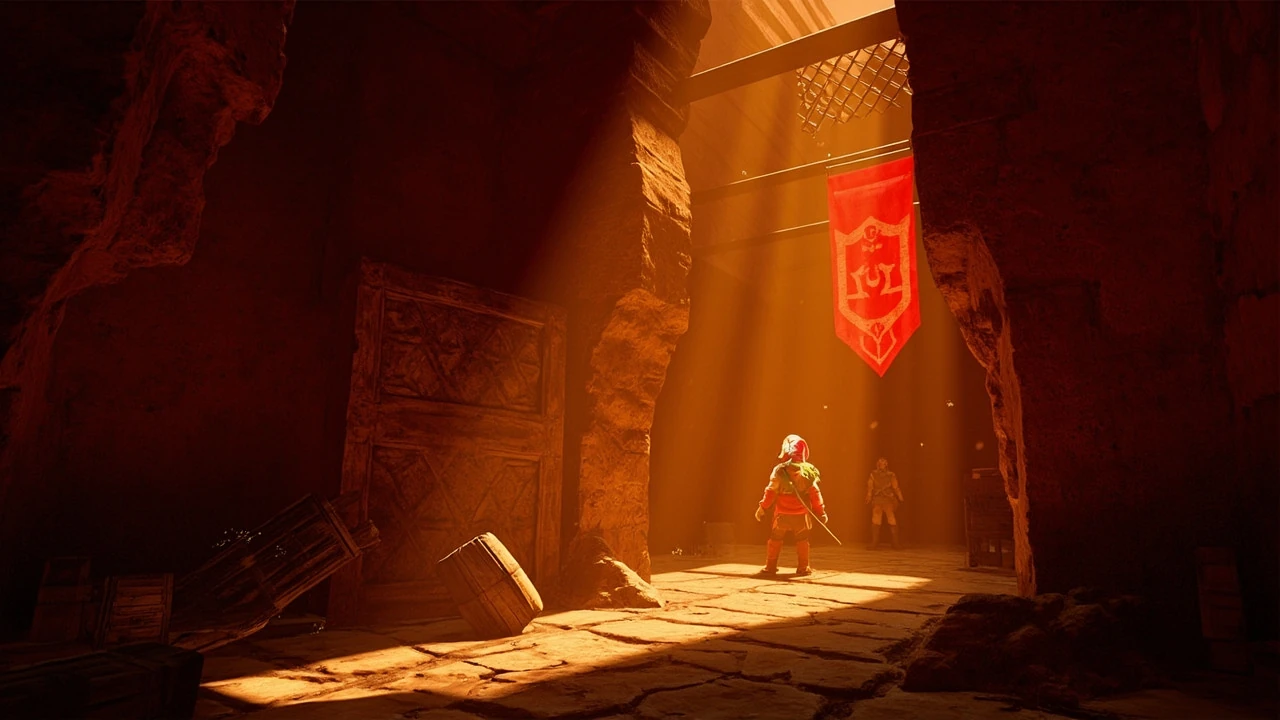
Yiga clan hideout in TOTK: what this dungeon actually asks of the player
The Yiga Clan Hideout is the first real stealth challenge most players meet in The Legend of Zelda: Tears of the Kingdom. It sits in a concealed canyon north of Gerudo Town and pulls the camera away from the open-world sandbox into a tight, scripted space with no climbing, no gliding, and no paraglider. Every encounter is solved by avoiding a line of sight rather than by combat, which is why the dungeon is such a useful design study for anyone who builds games for a living. The encounter tests pathing, line-of-sight checks, audio cues, level-of-detail swaps, and a scripted set piece that would be very familiar to anyone who has built an AI behaviour tree or a stealth encounter in Unreal, Unity, or Godot. The rule of the room is simple: if a footsoldier sees Link, the room is lost. There is no second wind, no panic roll, and no last-second parry. The encounter punishes carelessness immediately and rewards patience consistently, which is a meaningful shift in tone for a game that normally lets the player solve problems with improvised vehicles.
This article treats the location as a player guide and as a small case study in dungeon design. The walkthrough stays grounded in the released version of the game, focuses on the mechanics the encounter actually teaches, and points out the design choices that make the corridor feel tense without throwing difficult enemies at the player. The reward at the end is meaningful but not overpowered, which is itself an interesting design decision worth pausing on. The Piece of Heart that finishes the hideout is one of the cleaner examples of how to give a player a permanent upgrade without trivialising the rest of the map, and the way the encounter handles scaling is a small lesson in its own right.
How to start the Yiga Clan Hideout quest in TOTK
The dungeon only opens after the main story pushes Link into the Gerudo region in search of the Thunder Helm. Addri runs the clothing shop in Gerudo Town and recognises Link on the first visit, which unlocks the conversation that leads to the hideout. The quest hook is short on purpose: Addri explains that the Yiga have a base nearby, hands over a specific piece of clothing, and points the player at the canyon entrance north of the town. The whole chain is intended to feel like a single short quest rather than a multi-hour setup. There is no optional flag, no hidden prerequisite, and no faction that the player has to grind before the conversation fires. The trigger is one NPC, one line of dialogue, and one doorway.
For developers, this matters because the trigger is tightly coupled to a specific NPC and a specific region. The game does not use a generic quest log flag, which is a deliberate choice to keep the narrative beats readable. New players who skip the Gerudo clothing and try to walk in cold will still see the canyon, but the entrance will not respond until the conversation has fired. This is a small but useful pattern: location gating plus NPC gating, with the NPC acting as the quest authority rather than the world itself. A designer reading the chain can see how the system avoids the classic failure mode in which a quest silently refuses to start because of a state flag that was set in a different region. Addri’s line of dialogue is both the trigger and the documentation, and that combination is what keeps the encounter approachable.
Prerequisites before entering the hideout
- Reach Gerudo Town and speak with Addri at the clothing shop.
- Obtain the disguise clothing she provides; it is required to enter the town gates again without being attacked.
- Progress the main questline to the point where the Thunder Helm is the current objective.
- Bring a quiet weapon or a few elemental bundles; the disguise is for the entrance, not for the interior.
- Clear the immediate area of the canyon mouth so the footsoldier patrols do not catch Link on the way in.
If any of these is missing, the canyon entrance will either be inert or the player will be pushed back by guards at the town gate. This combination of soft gating and hard gating is a good reference for how quest prerequisites can be layered without using a generic failure screen. The hard gate stops progression, and the soft gate hides the trigger behind an NPC, so the player is never confused about why the dungeon is closed. A short, readable reason for closure is one of the most underused tools in quest design, and the Yiga chain uses it consistently.
Reaching the canyon entrance without tripping the disguise
The entrance sits in a side canyon to the north of the town, marked by a large crack in the rock and a wooden palisade. From Gerudo Town, the shortest route is to leave through the northern exit, follow the cliff path around the perimeter, and drop down into the ravine on the right. There is a fast travel point nearby once the player has activated it, but the first visit is on foot. A good rule is to stay on the high path and only descend when the canyon walls force the route; staying high avoids the band of Yiga scouts that patrol the lower ledges. The scouts are not a hard gate, but they will aggro if Link crosses their patrol line, and a fight at the entrance is a waste of weapon durability that the player would rather spend inside the dungeon.
The disguise clothing is not a stealth outfit in the modern sense. It is a permission check. The model simply removes the aggro radius from the Gerudo guards at the gate, so the player can re-enter the town without being attacked. Inside the hideout, the disguise has no effect at all, which is an honest design choice: stealth and disguise are two different systems, and the game keeps them separated rather than letting one item do both jobs. That separation is one of the cleaner pieces of quest logic in the game, and it gives the designer room to teach each system in its own space. A single outfit that solved both problems would have flattened the encounter and removed the need for the corridor at all.
Common entry mistakes
- Running into town with a hot head and triggering the guard aggro before speaking to Addri.
- Gliding into the canyon from too high; the entry point is below the cliff line and the wind currents can push the player into the wall.
- Wasting a weapon on the Yiga scouts at the canyon mouth; they are decoys and respawn quickly.
- Equipping cold-resistant armour and walking past a Satori light without picking up a useful weapon.
- Equipping the disguise inside the canyon and assuming the hideout patrols will not aggro; the costume does nothing indoors.
Each of these mistakes is recoverable. The disguise mistake in particular is the one that most players make on a first run, because the costume icon stays equipped and the player assumes it is still working. The game does not surface a warning, which is a deliberate omission: the encounter is short enough that learning by doing is faster than reading a tutorial. This is part of why the Yiga Clan Hideout is a useful reference for a stealth chapter that wants to teach without lecturing.
The stealth layout: how the hideout is actually designed
Once inside, the Yiga Clan Hideout is a single linear corridor with three connected chambers and a final room. The level is short on purpose, and that shortness is part of the design. The player is not supposed to fail repeatedly and grind; they are supposed to read the room, move carefully, and reach the end with most of their resources intact. From a level design perspective, the encounter is a stealth tutorial that does not call itself a tutorial. The corridor runs roughly north to south, with a soft right turn near the inner hall and a wider opening for the leader chamber. There is no branching path, no second floor, and no hidden room behind a breakable wall. The linearity is the lesson.
The first room is a small guard post. A Yiga footsoldier patrols a square route, and the player has to slip past a single line of sight cone to reach the next door. The cone is short, the patrol is predictable, and there is a large barrel at the corner that always blocks the line for one full rotation. This is a classic stealth safe-room: a low-stakes puzzle that teaches the rule the rest of the dungeon will repeat. The visual language of the cone is obvious without being intrusive, and the music drops in volume when the player is undetected, which doubles as a feedback signal. The drop in volume is small but consistent, and the player learns to read it within a single rotation of the patrol.
Stealth rules the game enforces in this dungeon
- Line of sight is the only true aggro trigger; sound has a small radius but never escalates an alert.
- The disguise has no effect inside the hideout; stealth is the only safe option.
- Corpses and broken weapons despawn after a short timer, keeping the corridor clean.
- There is no climbing, no Ultrahand, and no paraglider inside the dungeon, which removes the sandbox toolkit.
- Save points and fast travel are disabled until the player returns to the surface.
- Crouching reduces the line-of-sight cone by a small amount, which is enough to slip past a square patrol.
Disabling the sandbox toolkit is a strong choice. It forces the player to learn the rules of the room instead of solving every problem with a creative vehicle. For developers, this is a useful pattern to remember: stripping the player of the meta-tools they have spent forty hours building is sometimes the most honest way to teach a new system. The pattern works because the room is small enough that the loss of the toolkit is felt as a constraint rather than a punishment. A longer dungeon with the same constraint would start to feel hostile, and the Yiga encounter is calibrated carefully to avoid that.
Room-by-room walkthrough of the Yiga Clan Hideout
The dungeon runs from a guarded entrance to a single mini-boss, and the rooms in between are small enough that a written walkthrough is more useful than a video. The table below summarises each space, the threat inside, the safe route, and the small reward that the room usually hides. Times and distances are approximate because the level is short and the player should not be in a hurry. The descriptions are written for a first-time visitor who wants to clear the dungeon without losing resources, and they assume that the player has the standard Gerudo-region loadout rather than a custom stealth build.
| Room | Threat | Safe route | Reward |
|---|---|---|---|
| Entrance guard post | One Yiga footsoldier, square patrol | Wait behind the barrel at the corner, slip through during the rotation | Two arrows, a small chest with rupees |
| Outer corridor | Two footsoldiers on a shared patrol | Crouch behind the stone divider, move between the patrol gaps | Yiga schematic, a bow |
| Inner hall | One archer on an elevated platform | Stay behind the support pillar, throw a pot to break line of sight | Shock fruit, a chest with a key item |
| Leader chamber | Master Kohga mini-boss | Dodge the slam attack, return thrown boulders, finish the cutscene | Piece of Heart, access to the surface exit |
Each room escalates a single variable: more patrols, a longer line of sight, or a higher vantage point. The pattern is consistent enough that a player who understands the first room can read the rest without further instruction, which is exactly the kind of stealth pacing that a designer wants to encourage. The escalation is also slow enough that the player can recover from a mistake without losing the run, which is what makes the encounter feel fair rather than punishing. A designer who is building a similar stealth chapter can lift the structure directly: a single rule, a slow escalation, and a short cinematic at the end.
What the outer corridor teaches
The outer corridor adds a second patrol that overlaps with the first. The shared patrol creates small windows where both footsoldiers are looking away from the player’s path, and the safe route is to time a crouch run through those windows. The room also introduces a closed door that the player cannot open from the patrol side. This is a soft lesson: there is always another way around, and the designer is willing to gate an obvious route to push the player into the intended path. From a scripting perspective, the door is a one-way trigger that opens from the back, not a lock that needs a key, which keeps the player moving forward instead of fiddling with the interface. A trigger-based door is also a useful pattern for tutorial levels because it removes the prompt to interact and lets the level geometry do the work of directing the player.
What the inner hall teaches
The inner hall is the first room with a vertical threat. A Yiga archer stands on a small platform above the player’s path and looks down on the corridor, so the safe route is to stay behind a support pillar and only move when the archer turns to reload. The room also hides a chest that is technically reachable but visually tucked behind a banner, which encourages a small amount of exploration without rewarding a long detour. A well-placed throwable pot is the cleanest way to break the line of sight if the player is detected, and the game supplies a couple of pots near the entrance as a soft hint. The archer’s reload animation is the longest pause in the encounter, and learning to read it is what lets the player cross the hall without breaking stealth.
Master Kohga: the mini-boss the hideout is built around
Master Kohga is the leader of the Yiga Clan in this chapter of the story, and the hideout is essentially the frame for his encounter. He is a large, teleporting human who fights by slamming the ground and throwing boulders. The encounter runs in three phases, and each phase is short. The first phase is a tutorial in dodging his slam attack and returning a boulder. The second phase adds a second boulder and a small line of sight cone. The third phase is a short cinematic that ends the fight. None of the phases depend on the weapons the player brought, which is a deliberate design decision: the hideout is a story beat, not a gear check. The fight is also the only moment in the dungeon where the music rises in volume, which signals to the player that the stealth rules are no longer in effect.
For developers, the encounter is a clean example of a story-driven mini-boss that scales variety rather than raw difficulty. Each phase adds a new behaviour without raising the health pool or the damage output, and the player is rewarded for staying calm rather than for landing long combos. The fight is also forgiving in a way that most open-world mini-bosses are not: the room reloads on a death, the player keeps their resources, and the cutscene always plays the same way. This combination is a useful reference for any studio that wants to put a small story boss in the middle of a long campaign without breaking the pacing.
How to handle each Kohga phase
- Phase one: stay near the centre of the room, dodge the slam by stepping sideways, and return the boulder by hitting it back with any melee weapon.
- Phase two: keep moving around the pillars, return the second boulder, and stay out of the line of sight cone that appears behind the player.
- Phase three: watch the cinematic, do not mash buttons, and pick up the drops when the room reloads.
The fight is intentionally forgiving because the dungeon is supposed to be a story reward, not a skill test. The Piece of Heart is the actual reward; the fight is the framing. A designer reading the encounter can see how the encounter scales difficulty without escalating the actual threat, which is a useful pattern for a story-driven mini-boss. For broader context on the series that frames this encounter, the Legend of Zelda entry is a useful starting point for new readers.
Rewards, item unlocks, and what the hideout actually gives back
Finishing the Yiga Clan Hideout unlocks a small set of permanent rewards. The exact list is short, which keeps the encounter feeling like a narrative beat rather than a farming target. The rewards are also calibrated to the cost of the dungeon: a ten-minute stealth chapter that gives a permanent stat increase, a small stack of consumables, and the quest progress the player came for. There is no unique weapon, no expensive armour, and no crafting material that would change the wider economy of the game. The hideout gives enough to feel rewarding and not enough to feel exploitative, which is a balance that many open-world games struggle to hit.
| Reward | Type | Where it shows up next |
|---|---|---|
| Piece of Heart | Container upgrade, increases effective hearts | Health bar after the first four are collected |
| Access to the surface exit | Quest progression | Leads back to the canyon mouth and the Gerudo region |
| Yiga schematic | Crafting reference for Yiga-themed builds | Available in the outer corridor chest |
| Small chest contents | Rupees and arrows | Stored in the player’s wallet on exit |
The reward set is a useful reference for designers who are balancing a short dungeon. The hideout gives a permanent stat increase, a crafting reference, a small stack of consumables, and the quest progress that the player came for. There is no unique weapon and no expensive armour, which keeps the encounter from trivialising the open-world economy. A short dungeon that gives too much loot tends to flatten the rest of the map, and the Yiga Clan Hideout is a clean example of how to avoid that. The chest in the inner hall is also worth picking up because the key item it contains is required for a small side quest later in the Gerudo region, which is a small but useful reward for a careful player.
How the Yiga Clan Hideout compares to other TOTK dungeons
Tears of the Kingdom has four main regional dungeons plus a small set of story dungeons, and the Yiga Clan Hideout sits between a story dungeon and a tutorial dungeon. It is shorter than the regional dungeons, does not feature a regional sage, and does not require a full item set. It is also more scripted than the regional dungeons, which lean heavily on Ultrahand, Ascend, and Recall. The hideout is the only major interior that strips the sandbox toolkit almost entirely, which is why it stands out as a stealth tutorial disguised as a story beat. The regional dungeons are built around the abilities Link has collected, and the hideout is built around the abilities Link does not have, which is an interesting inversion of the usual design logic.
The comparison is also useful because it shows how a single game can support several different player fantasies without breaking the progression curve. The hideout teaches stealth, the regional dungeons teach the abilities, and the open world teaches the systems. Each layer has its own design language, and the game does not blur the lines between them. A player who finishes the hideout will feel that they have learned a new skill, while a player who finishes a regional dungeon will feel that they have used an old skill in a new context. The difference is small, but it is what keeps the campaign from feeling repetitive over forty hours of play.
How the hideout differs from the regional dungeons
- It is shorter, with fewer rooms and a single mini-boss instead of a full boss.
- It does not unlock a sage or a regional ability; its main reward is a Piece of Heart.
- It removes the sandbox toolkit, while the regional dungeons use every Ultrahand ability in rotation.
- It is the only major interior that depends on line-of-sight stealth rather than puzzle or combat loops.
- It does not contribute to the regional map completion tracker, which keeps the reward local to the story arc.
For developers, the comparison is useful because it shows how a single dungeon can support a different player fantasy without breaking the overall progression curve. The hideout teaches stealth, the regional dungeons teach the abilities, and the open world teaches the systems. Each layer has its own design language, and the game does not blur the lines between them. The hideout is also a useful reference for studios that want to put a stealth chapter in the middle of an open-world game without pulling the player out of the campaign for too long. A short, linear corridor with a single rule is enough to teach the system, and the rest of the game can build on that foundation.
Design patterns the Yiga Clan Hideout uses well
The encounter reads like a small design lecture once you start pulling it apart. It uses a small number of well-known stealth patterns and arranges them in a way that is easy to read on a first playthrough. The list below is a short summary of the patterns a developer can lift directly from the encounter, along with a note on why each pattern works in this specific room. None of the patterns are unique to the Yiga Clan Hideout, and most of them appear in other stealth games, but the way the encounter stacks them is what makes the corridor feel coherent.
- A single safe-room at the start that teaches the aggro rule without a death cost.
- Patrols that share a path, which creates predictable windows and avoids the need for synchronised AI.
- A vertical threat in the inner hall that introduces elevation without changing the core rule.
- A mini-boss that escalates variety, not difficulty, which keeps the story beat intact.
- Rewards that progress the player without flattening the wider economy.
- A linear corridor that removes branching paths, so the player always knows which direction to move.
- A short cinematic at the end that signals the rules of the room have changed, which is useful for pacing.
None of these patterns are new on their own. What is useful is the way the encounter stacks them in a short, linear space. The dungeon runs about ten minutes for a careful player, which is roughly the length of a single stealth chapter in many indie games. That pacing is worth studying, because it shows how to teach a system in a small box. A stealth chapter that runs longer than fifteen minutes tends to lose the player’s attention, and a chapter that runs shorter than five minutes tends to feel like a cutscene. The Yiga encounter sits in the middle, which is where most stealth tutorials belong.
Common questions about the Yiga Clan Hideout in TOTK
Before the frequently asked questions section, it is worth noting that the Yiga Clan Hideout is one of the most replayed interiors in the game for players who are learning stealth. The questions below are the ones that come up most often in community threads and that have the most useful answers for first-time visitors. They cover the entrance, the disguise, the sandbox toolkit, and the Master Kohga fight, which are the four areas where new players tend to get stuck.
Do I need the Gerudo disguise to enter the Yiga Clan Hideout?
You need the disguise to move freely in Gerudo Town and to unlock the quest, but the disguise is not required once you are inside the hideout itself. Stealth, not costume, is the rule that the dungeon enforces. The disguise is a permission check, and the hideout is a separate stealth system.
Can I use Ultrahand or Ascend inside the hideout?
No. The interior is designed to remove the sandbox toolkit so the stealth rules are the only system in play. Ultrahand, Ascend, Recall, and the paraglider are disabled inside the dungeon, which forces the player to learn the room rather than to bypass it. The restriction is consistent with the design choice to keep the encounter short and readable.
What is the best weapon to bring into the Yiga Clan Hideout?
Any quiet melee weapon or a bow with shock fruit is enough. The hideout is not a gear check, so the player does not need to grind before entering. A few throwable pots are also useful in the inner hall if the line of sight is broken. A high-damage two-handed weapon is overkill for a stealth chapter and will mostly sit in the inventory until the Master Kohga fight.
Is Master Kohga a required boss in the main story?
Master Kohga is required as part of the Gerudo arc. Defeating him is the only way to clear the Yiga Clan Hideout and progress the Thunder Helm storyline, so the encounter is a story gate as well as a stealth tutorial. The fight is not optional, and the game does not offer a stealth path past the leader chamber.
What is the best way to dodge Master Kohga’s slam attack?
Step sideways out of the impact ring as soon as his hands leave the ground. The window is generous, and the impact ring is a clear visual cue. Dodging sideways keeps the player close enough to return the boulder, which is the cleanest way to advance the fight. A backstep is too long and tends to push Link out of range for the return throw.
Are there any missable items in the Yiga Clan Hideout?
There is one small chest in the outer corridor and a second chest in the inner hall. Both are reachable on a careful run, and neither is hidden behind a puzzle that can be skipped. A careful player will collect both without a guide, but a player who rushes the dungeon may miss the inner hall chest because it is tucked behind a banner and is easy to overlook on a first pass.
Does the Yiga Clan Hideout respawn enemies after I leave?
Yes. The hideout is a standard interior, which means it respawns on the same in-game cycle as other dungeons. The respawn is not used as a farming loop, because the loot is small and the encounter is short. A player who wants to farm the Yiga schematic will find that the respawn timer is long enough that the dungeon is not a practical target.
Can I fast travel out of the Yiga Clan Hideout if I get stuck?
Fast travel is disabled inside the hideout, but the player can leave through the entrance at any time. Quitting the game and reloading puts Link back at the last save point, which is normally the canyon mouth. The dungeon does not trap the player, and there is no softlock state in the released version of the encounter.
Does the Yiga Clan Hideout count toward a dungeon completion reward?
It counts as a story dungeon rather than a regional dungeon, so it does not contribute to the regional map completion tracker. The reward for clearing the hideout is the Piece of Heart and the quest progress, not a separate map marker. The distinction matters for players who are trying to clear the map at 100 percent, because the hideout will not show up on the regional tracker.
Is the Yiga Clan Hideout a good place to learn stealth in TOTK?
It is the best place in the game to learn the basic stealth rule. The corridors are short, the patrols are predictable, and the visual cues are clear. A player who has finished the hideout will have an easier time in the few later encounters that use line-of-sight detection, because the core rule has already been taught. The hideout is also a useful reference for designers who want to teach a system in a small space without breaking the pacing of the wider campaign.
Frequently asked questions
What level should I be before entering the Yiga Clan Hideout?
There is no explicit level recommendation because the hideout is a story dungeon rather than a combat challenge. The encounter depends on stealth rather than on health or weapon damage, so any reasonable loadout from the Gerudo region is enough. Players who arrive straight from the main story beat will be ready, and players who have been exploring will not be over-prepared. A full heart container is more than enough, and a small stock of food is plenty for the Master Kohga fight.
Does the disguise clothing break during the Yiga Clan Hideout?
The disguise does not break inside the hideout, because it is never active there. The clothing stays in the inventory and remains useful for re-entering Gerudo Town, but the game does not let it interact with the hideout’s stealth system. Keeping the two systems separate is part of the design, and the player can swap to a combat outfit before the Master Kohga fight without losing any progress.
Can I use amiibo items inside the Yiga Clan Hideout?
Amiibo drops can be used inside the hideout, but they are not required. The encounter is short enough that a small amiibo boost is rarely necessary, and the dungeon does not gate any of its rewards behind amiibo content. A player who is using amiibo for the wider campaign will see the usual drops, but the drops do not change the structure of the fight or the layout of the corridor.
What happens if Master Kohga defeats me?
Link respawns at the entrance of the leader chamber with all of his resources intact. The mini-boss is part of a story encounter, so the game does not charge a death penalty inside the hideout. This is one of the reasons the encounter is a good reference for a forgiving story boss, and it is also why the fight feels approachable even for players who are not used to dodge-based combat.
Is there a shortcut back to the canyon mouth from the leader chamber?
Yes. After the Master Kohga cutscene, the game opens a short path that leads back to the canyon mouth. The shortcut is a one-way door during the encounter and a regular exit after the fight, which is a small but useful pattern for keeping the player oriented. The exit also skips the stealth corridor, which is a welcome relief for a player who has already cleared the dungeon on a previous run.
Can I skip the Yiga Clan Hideout entirely?
No. The hideout is required to clear the Thunder Helm arc, which is part of the main story. Skipping the dungeon is not an option, but the encounter is short enough that it does not act as a major progression wall. A player who is stuck on the Master Kohga fight can leave the dungeon and return later, but the game will not progress the Thunder Helm storyline until the encounter is cleared.
Does the Yiga Clan Hideout change on a second playthrough?
The hideout does not change on a second playthrough in the released version of the game. The patrol routes, the chest contents, and the Master Kohga phases are scripted the same way on every run, which is part of the reason the dungeon works as a tutorial. A new game plus run will replay the same encounter with the same layout, and the player can use the repetition to refine a stealth route.
How long does the Yiga Clan Hideout take to clear?
A careful first run usually takes around ten minutes, including the Master Kohga fight and the chest pickups. A player who already knows the routes can clear the dungeon in under five minutes, which is a useful benchmark for designers who are scoping similar stealth chapters. A player who is still learning the rules should expect to take a few extra minutes on the outer corridor, where the shared patrol is the hardest part of the room to read.
Is the Yiga Clan Hideout accessible for players who avoid combat?
Yes. The hideout is built around stealth rather than combat, so a player who never swings a weapon can clear the dungeon by avoiding every line of sight cone. This is one of the more accessible stealth encounters in the game, and it is a useful reference for designers who want to support a pacifist or low-combat playstyle. The only required fight is the Master Kohga encounter, and that fight is short enough that a pacifist player can clear it with a few dodges and a single return throw.
Where does the Yiga Clan Hideout fit in the wider TOTK story?
The hideout is the mid-point of the Gerudo arc. It unlocks the next phase of the Thunder Helm storyline and leads the player back into the open world with a Piece of Heart and a clean route to the rest of the desert content. The encounter is also a useful waypoint for designers who are mapping the campaign, because it sits between the open-world sandbox and the regional dungeon that follows it. A player who is planning a route can use the hideout as a checkpoint and reset their exploration from there.
Related reads from the studio:

Leave a Reply